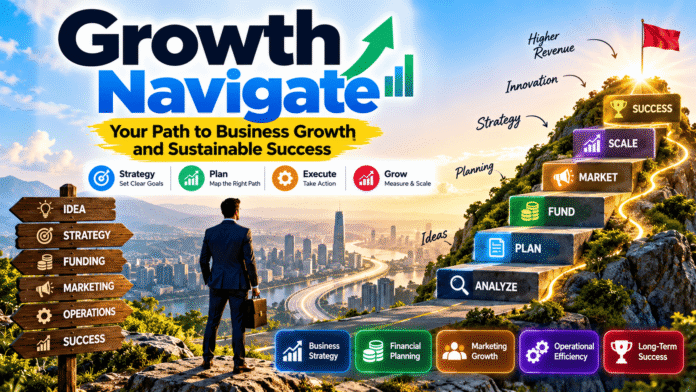
Growing a business requires more than a great idea. Entrepreneurs need a clear strategy, effective financial management, the right technology, and a deep understanding of their customers. Without a structured plan, even promising businesses can struggle to generate consistent revenue or scale successfully. This is where the concept of Growth Navigate becomes relevant.
Growth Navigate is a term associated with finding a clear path toward business growth through strategic planning, resource management, customer acquisition, and continuous improvement. It can also refer to websites that publish business growth resources or offer advisory services to startups and established companies.
For entrepreneurs, startup founders, and small business owners, understanding growth strategies can help identify new opportunities, reduce unnecessary expenses, and build a more sustainable business model.
In this guide, we will explore what Growth Navigate means, how businesses can use growth strategies effectively, which tools can support expansion, and how to create a practical roadmap for long-term success.
What Is Growth Navigate?
Growth Navigate refers to the process of identifying business goals and choosing practical strategies to achieve them.
Rather than expanding without a clear direction, businesses can use a structured approach to understand their current position, identify opportunities, allocate resources, and measure progress.
The term is also associated with the website GrowthNavigate.com, which describes its focus as helping businesses obtain funding, improve financial systems, and scale more profitably. Its published services include business funding, financial advisory, financial planning, investment strategy, and fintech solutions.
Because several websites use similar Growth Navigate names, it is important to check the exact domain before assuming that different services or tools belong to the same organization.
At a strategic level, the Growth Navigate approach can be understood through five essential activities:
- Planning: Define specific business goals and priorities.
- Analysis: Understand customers, competitors, costs, and market opportunities.
- Execution: Implement strategies that support measurable objectives.
- Measurement: Track results using relevant business metrics.
- Optimization: Improve processes based on evidence and performance.
These activities help businesses replace guesswork with more informed decision-making.
Why Is Growth Navigation Important for Businesses?
Business growth creates opportunities, but it also introduces challenges. Increasing sales can require additional inventory, employees, technology, customer support, and working capital.
Without careful planning, rapid expansion can increase costs faster than revenue.
A structured growth strategy helps businesses address these challenges before they become serious problems.
1. Clear Business Direction
A defined strategy helps business owners prioritize activities that contribute directly to their objectives.
For example, an online store may decide to focus on increasing repeat purchases instead of continuously spending more on customer acquisition.
Clear priorities make it easier to allocate time, money, and staff effectively.
2. Better Financial Management
Revenue alone does not determine whether a business is healthy.
Companies must also understand profit margins, operating expenses, cash flow, outstanding payments, and future financial obligations.
Monitoring these figures helps business owners recognize potential problems before they affect daily operations.
3. More Effective Customer Acquisition
A growth strategy helps identify which marketing channels attract the most relevant customers.
Depending on the business, these channels might include SEO, paid advertising, email marketing, social media, partnerships, or referrals.
Rather than investing equally in every channel, businesses can measure performance and concentrate on opportunities that deliver sustainable results.
4. Improved Operational Efficiency
As a business grows, manual processes can become difficult to manage.
Automation, documented workflows, and appropriate software can reduce repetitive work and improve consistency.
However, businesses should fix inefficient processes before automating them. Technology cannot automatically solve a poorly designed workflow.
5. More Sustainable Expansion
Sustainable growth balances revenue opportunities with operational capacity and financial stability.
A business should understand whether it can deliver its products or services consistently before accepting significantly more demand.
This approach can help protect customer satisfaction while reducing unnecessary financial pressure.
Key Growth Navigate Strategies for Startups
Startups often operate with limited funding, small teams, and uncertain market demand. Their growth strategies should therefore focus on learning quickly and using resources efficiently.
Identify a Clear Target Audience
Start by identifying the customers who are most likely to benefit from your product or service.
Consider their problems, purchasing behavior, budgets, and expectations.
A clearly defined audience makes it easier to develop relevant marketing messages and choose suitable sales channels.
For example, a software startup serving small businesses may prioritize affordability and ease of use, while an enterprise software provider may focus on security, integrations, and scalability.
Validate Your Business Idea
Before investing heavily in expansion, determine whether customers genuinely want the product or service.
You can validate demand through customer interviews, surveys, small advertising campaigns, pilot programs, and early sales.
Actual purchasing behavior often provides stronger evidence than positive feedback alone.
Develop a Repeatable Sales Process
A repeatable sales process helps businesses understand how potential customers move from initial awareness to purchase.
Document the steps involved in lead generation, qualification, follow-up, proposals, and closing.
Tracking conversion rates at each stage can reveal where potential customers are being lost.
Focus on Customer Retention
Acquiring new customers is only one part of growth.
Businesses can also improve performance by delivering better customer experiences, offering reliable support, and encouraging repeat purchases.
Retention strategies should be appropriate for the product. Subscription businesses, for example, may focus on reducing cancellations, while retailers may focus on repeat orders and customer loyalty.
Build a Scalable Operating Model
As demand increases, businesses need processes that can handle additional work without creating excessive costs.
Document standard procedures, define responsibilities, monitor quality, and use technology where it provides measurable value.
The objective is not to eliminate human involvement. It is to create an operating system that supports growth without unnecessary complexity.
How Financial Planning Supports Business Growth
Financial planning is an essential part of any serious growth strategy.
A business may generate strong sales while still experiencing financial difficulties if customers pay late, operating expenses rise, or inventory consumes too much cash.
Growth Navigate-related financial resources emphasize the importance of funding, profitability, cash flow, and financial planning.
Understand Your Cash Flow
Cash flow tracks the movement of money into and out of a business.
Review expected customer payments, supplier invoices, payroll, taxes, loan repayments, and other obligations.
A rolling cash flow forecast can help business owners anticipate periods when available cash may be insufficient to cover expenses.
Calculate Your Profit Margins
Revenue indicates how much a business sells, but margins help explain how much it retains after relevant costs.
Monitor gross profit, operating expenses, and net profit to understand whether sales growth is improving the business’s financial position.
Discounts that increase sales volume may still reduce overall profitability if margins become too small.
Plan Funding Carefully
Businesses may require additional capital to hire employees, purchase inventory, develop products, or enter new markets.
Potential funding sources include retained earnings, business loans, equity investment, and other financing arrangements.
Each option has different costs, eligibility requirements, risks, and implications for ownership.
Before accepting funding, evaluate repayment obligations, fees, investor terms, and the effect on future cash flow.
Build a Financial Buffer
Unexpected expenses, delayed payments, and changing market conditions can affect business operations.
Maintaining an appropriate cash reserve can provide flexibility during difficult periods.
The right reserve depends on the business model, expense structure, revenue stability, and access to financing.
The Role of Digital Marketing in Business Growth
Digital marketing can help businesses reach relevant audiences, communicate their value, and generate sales opportunities.
However, the right marketing mix depends on the target customer, competition, budget, and business objectives.
Search Engine Optimization
SEO helps websites improve their visibility in organic search results.
A practical SEO strategy includes keyword research, useful content, technical optimization, internal linking, and performance measurement.
Businesses should prioritize search queries that reflect real customer needs instead of publishing large volumes of repetitive content.
Content Marketing
Content marketing helps businesses answer customer questions and explain their products or services.
Useful content can include educational articles, tutorials, case studies, comparison guides, and detailed service pages.
The most effective content provides original value and supports the reader’s decision-making process.
Paid Advertising
Paid advertising can help businesses reach targeted audiences more quickly than organic channels alone.
However, advertising costs can rise rapidly if campaigns attract unqualified traffic or fail to convert visitors.
Measure cost per lead, customer acquisition cost, conversion rate, and return on advertising spend where appropriate.
Email Marketing
Email marketing allows businesses to communicate with customers who have chosen to receive their messages.
Businesses can use email for product education, updates, customer onboarding, and repeat-purchase campaigns.
Relevant messaging, permission-based contact lists, and appropriate frequency are important for maintaining trust.
Conversion Rate Optimization
Conversion rate optimization focuses on helping more website visitors complete useful actions, such as making a purchase or requesting a consultation.
Improvements might include clearer calls to action, simpler forms, better product information, and faster page loading.
Test changes systematically rather than assuming that every design adjustment will improve results.
Growth Navigate Tools That Can Help Businesses Scale
Technology can support business growth by improving visibility, reducing manual work, and helping teams coordinate their activities.
The right tools depend on the company’s size and needs.
Project management tools: Help teams organize tasks, assign responsibilities, and monitor deadlines.
Customer relationship management systems: Track leads, customer interactions, and sales opportunities.
Analytics platforms: Help measure website traffic, campaign performance, and customer behavior.
Accounting software: Supports expense tracking, invoicing, and financial reporting.
Automation tools: Connect systems and reduce repetitive administrative tasks.
Communication platforms: Help teams coordinate projects and share information.
Before choosing software, identify the problem you want to solve, compare total costs, check integration requirements, and consider data security.
A smaller, well-integrated technology stack is often more useful than purchasing many tools that perform overlapping functions.
How to Measure Business Growth Effectively
Business growth should be measured using indicators that reflect the company’s actual objectives.
The most useful metrics vary by industry and business model.
| Metric | What it tells you |
|---|---|
| Revenue growth | Whether sales are increasing over time |
| Gross profit margin | How much revenue remains after direct costs |
| Net profit margin | How much profit remains after expenses |
| Customer acquisition cost | How much it costs to acquire a customer |
| Customer retention rate | How effectively the business retains customers |
| Cash flow | Whether the business can meet its financial obligations |
| Conversion rate | How effectively prospects complete desired actions |
These metrics should be interpreted together.
For example, revenue may rise while profit margins decline. Similarly, a business may generate more leads without increasing sales if lead quality or conversion rates deteriorate.
Establish a baseline, set realistic targets, and review performance consistently.
A Practical 90-Day Growth Navigate Plan
A structured 90-day plan can help a business move from analysis to implementation without attempting to change everything simultaneously.
Days 1–30: Analyze and Prioritize
Review current revenue, costs, customers, marketing channels, and operational processes.
Identify the three most important barriers to growth.
Set specific targets and determine which activities are most likely to address those barriers.
Days 31–60: Implement and Test
Launch focused initiatives based on the initial analysis.
Examples include improving high-value website pages, testing a new sales process, reducing unnecessary expenses, or introducing a customer retention campaign.
Assign an owner to each initiative and define how success will be measured.
Days 61–90: Measure and Optimize
Compare results against the original baseline.
Identify which initiatives improved performance, which failed to produce meaningful results, and which require more testing.
Allocate additional resources to successful activities while adjusting or stopping ineffective ones.
At the end of the period, create the next 90-day plan using the evidence collected.
This process encourages continuous improvement without assuming that every growth experiment will succeed.
Common Business Growth Mistakes to Avoid
Even well-planned businesses can encounter difficulties when expanding.
Some common mistakes include:
- Expanding before validating customer demand.
- Focusing on revenue while ignoring profitability.
- Spending too much on customer acquisition.
- Hiring faster than operational needs justify.
- Taking on debt without a repayment plan.
- Investing in software without clear requirements.
- Ignoring customer feedback.
- Failing to monitor cash flow.
- Entering new markets without sufficient research.
The solution is not to avoid every risk. It is to understand the risks, test assumptions, and make decisions based on evidence.
Frequently Asked Questions About Growth Navigate
1. What is Growth Navigate?
Growth Navigate refers to finding and following a structured path toward business growth through planning, financial management, marketing, operational improvement, and performance measurement. The name is also used by websites that publish growth resources or offer business-related services.
2. What is the Growth Navigate website?
GrowthNavigate.com describes itself as a provider of business funding, financial advisory, financial planning, investment strategy, and fintech-related services. Other websites use similar names, so verify the exact domain before relying on information about a particular business.
3. How can Growth Navigate help startups?
A structured growth approach can help startups identify target customers, validate demand, manage cash flow, improve customer acquisition, and measure performance.
The results depend on the quality of implementation and the business’s circumstances.
4. What are the most important business growth strategies?
Important strategies include understanding customer needs, improving product-market fit, building repeatable sales processes, managing finances, investing in effective marketing, and tracking performance.
The right priorities depend on the company’s stage and objectives.
5. Why is financial planning important for business growth?
Financial planning helps businesses forecast cash needs, manage operating costs, evaluate funding options, and understand whether expansion is financially sustainable.
It also helps identify potential cash shortages before they disrupt operations.
6. Which tools are useful for business growth?
Useful tools may include CRM systems, project management software, accounting platforms, analytics tools, and marketing automation solutions.
Choose tools based on specific operational needs rather than popularity alone.
7. How long does it take to see business growth?
The timeline varies by industry, business model, competition, and the strategy being implemented. Some improvements may be measurable within weeks, while others require several months or longer.
Set realistic expectations and measure progress using relevant indicators.
8. Is Growth Navigate suitable for small businesses?
Growth planning principles can be useful for small businesses because they help prioritize spending, identify opportunities, improve operations, and establish measurable objectives.
Any paid advisory service should be evaluated separately by reviewing its credentials, fees, contract terms, and suitability for your needs.
Conclusion
Growth Navigate represents a structured approach to building a stronger and more sustainable business.
By combining clear goals, financial discipline, effective marketing, appropriate technology, and consistent performance measurement, businesses can make better decisions about where to invest their time and resources.
GrowthNavigate.com is one website associated with this topic, offering business and financial growth resources. Readers should verify the exact website and independently evaluate any services before entering into financial or advisory arrangements.
Whether you are starting a new business or improving an established company, begin with a clear understanding of your current position, identify the most important opportunities, and implement changes that can be measured.
Sustainable growth is not simply about expanding faster. It is about building a business that can grow profitably, serve customers consistently, and adapt to changing conditions.