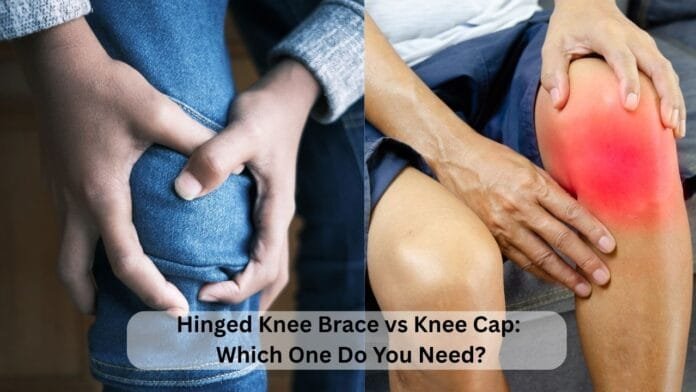
Knee discomfort and injuries are a concern that several individuals encounter at least once in their lifetime. Maintaining your joints’ health is basically a priority when you are an active athlete. This also applies to someone who enjoys weekend walks and someone managing day-to-day activities. You will usually find two main options when looking for knee support. These are a hinged knee brace and the knee cap in most cases. Both serve remarkable roles in joint care. The main distinct point is that they function through mechanisms that are different from each other.
Finding the right knee support aid can be overwhelming. You need a support aid that offers relief without restricting your knee movement.
This blog uncovers the differences between a hinged knee cap and a standard knee cap. It will help you understand which one is suitable for your current recovery requirements. You can make a choice that supports your movement and comfort. This can happen just by understanding how these knee supports function.
What is a Knee Cap?
A knee cap is basically what you commonly see in gyms and on walking paths. It is lightweight and easy to wear under clothes. Its function is to deliver compression. Compression helps to manage minor swelling. It also keeps the joint warm, which can improve blood flow to the area.
Features of a Knee Cap
- Flexible fabric construction
- Easy to pull on and off
- Low-profile design
- Provides mild to moderate compression
- Retains heat around the joint
People often use a knee cap for general soreness. It is helpful for individuals who feel a slight instability during light exercise. It acts as a reminder for the body to move carefully. This is known as proprioception. It helps your brain stay aware of the joint’s form.
What is a Hinged Knee Brace?
A hinged knee brace is more like a technical piece of equipment. It is crafted for those who need more than just compression. The side hinges are the most important part. They prevent the knee from moving in ways it should not.
These braces particularly stop lateral movement. Lateral movement is side-to-side shifting. The knee joint should mainly move back and forth. Ligaments can be strained if it shifts sideways. The hinged knee brace keeps the joint on the correct track.
Features of a Hinged Knee Brace
- Rigid side supports
- Mechanical hinges for guided movement
- Adjustable straps for a secure fit
- Open or closed patella designs
- Heavy-duty materials for durability
Knee Cap vs Knee Brace
| Feature | Knee Cap | Knee Brace |
| Main Objective | Compression and warmth | Stability and protection |
| Material | ElasticNeopreneKnit | MetalPlastic stays with fabric |
| Weight | Very light | Moderate |
| Support Level | Mild | High |
| Mobility | Full range of motion | Controlled range of motion |
| Best For | Minor pain and swelling | Ligament injuries and recovery |
| Visibility | Discreet under clothes | Noticeable under and on top of clothes |
When to Choose a Knee Cap
A knee cap is mostly suitable for everyday activities. If you enjoy walking and jogging but feel a bit of stiffness, this is often the first step. It is also beneficial for those with minor arthritis. The warmth provided by the sleeve can soothe stiff tissues.
You might choose a knee cap if you have
- Minor swelling after a long day of standing
- A feeling of tiredness in the joint
- Dull discomfort during exercise
- The need for a lightweight layer of protection
The simplicity of the knee cap is its greatest strength. It does not require complex fitting. It enables your muscles to stay active while providing a gentle hug-like feeling to the joint.
When to Choose a Hinged Knee Brace
There are times when a flexible sleeve is not enough. A hinged knee brace is a safer option if your knee feels like it might give out. This sensation of giving out usually points to ligament issues.
The hinges function as an external skeleton. They take some of the strain off the knee muscles. This is very helpful during the recovery phase of an injury. It enables you to move and walk while limiting the risk of a secondary injury.
Consider a hinged knee brace for
- Support after a severe ligament strain
- Stability during lateral sports like tennis and basketball
- Management of more complicated joint issues
- Protection during the return to physical activity after rest
- Keeping the knee aligned during heavy lifting
Wrapping Up
Your knee health basically affects your quality of life. Despite choosing a flexible knee cap or a sturdy hinged knee brace, you are taking a step toward better mobility. Both aids have a place in joint care.
The knee cap is a suitable companion for daily comfort and minor support. The hinged knee brace is a reliable protector for more complex conditions. Understanding these differences leads to an informed choice.
Simply prioritise how the support feels as you move. It should feel secure yet not painful. You are supposed to focus on your activities and recovery with comfort. Taking care of your knees today definitely helps you stay mobile for years to come.